
H2: Introduction
H3: The Limitations of Transmission: Beyond the Information Metaphor
For centuries, the dominant model of education has been one of information transmission. This “empty vessel” framework, or “banking concept” of education [CITE: Freire, 2018], posits the student as a passive recipient and the teacher as a transmitter of discrete knowledge packets. While simple, this model fails to explain the most critical aspects of learning: the “aha” moment, the stubborn persistence of misconceptions, and the emergent synthesis of disparate ideas into a coherent whole. It treats knowledge as a substance to be poured, rather than a structure to be built [CITE: Sfard, 1998].
This approach is increasingly untenable. It cannot account for the complex, high-dimensional nature of understanding recognized by modern cognitive science. It also fails to provide a rigorous mechanism for why some pedagogical interventions succeed and others fail, beyond appeals to “clarity” or “engagement.” We require a model that treats learning not as information reception, but as a structural change in the learner’s cognitive architecture.
H3: Thesis: Formalizing Instruction as Geometric Curvature Control
This article introduces a novel theoretical framework: Pedagogical Ricci Flow (PRF). We propose that instruction can be formalized as the targeted application of Ricci flow—a powerful concept from differential geometry—to a learner’s “cognitive manifold.”
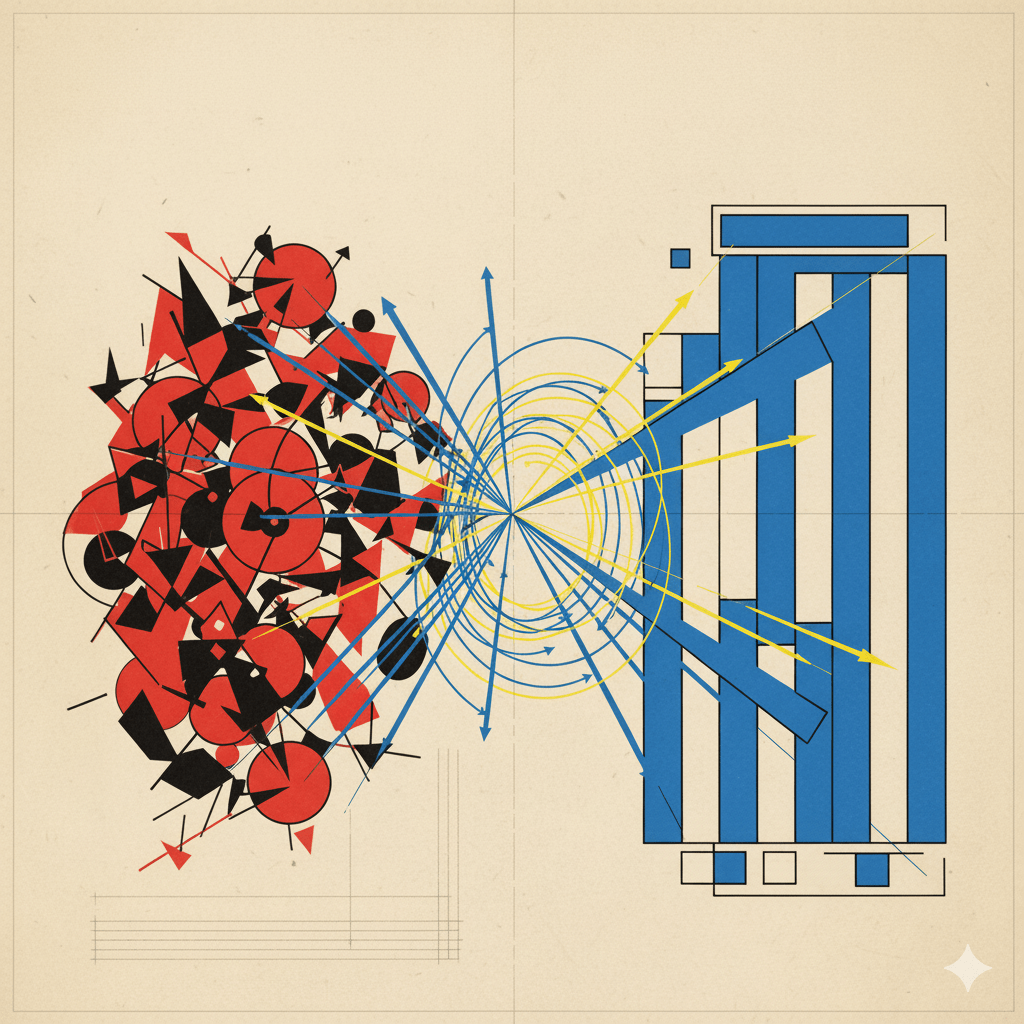
In this model, a learner’s understanding of a subject is represented as a high-dimensional geometric space. The “distances” between concepts in this space define its shape. Misconceptions are not mere errors; they are “curvature singularities”—pathological warps in the fabric of this space. Teaching, then, is the act of metric engineering: a controlled, local deformation of the metric to equilibrate conceptual distances, “smooth” these singularities, and optimize the manifold for efficient reasoning, all while preserving the learner’s core conceptual identity.
H3: Article Structure and Core Argument
This article will proceed in seven parts. First, we will operationalize the concept of the “cognitive manifold” and define its key geometric components. Second, we will introduce the theory of Pedagogical Ricci Flow (PRF), contrasting it with traditional models. Third, we will explore analogical evidence from machine learning and cognitive neuroscience. Fourth, we will address significant objections to this high-level formalism. Fifth, we will synthesize these ideas into a generative framework. Finally, we will discuss the practical implications for instructional design before concluding with the model’s core assumptions, limits, and falsifiable predictions.
H2: The Problem: Operationalizing the “Cognitive State”
H3: Defining the Cognitive Manifold: A Space of Conceptual Relationships
To formalize learning, we must first formalize the cognitive state. We define the Cognitive Manifold as a high-dimensional Riemannian manifold (M) where each point (p∈M) represents a possible cognitive state. The “space” itself is defined by a set of basis concepts, and a learner’s understanding is a point, or more accurately, a distribution, on this manifold.
Critically, the structure of this space is not arbitrary. It is endowed with a metric that quantifies conceptual similarity. Ideas that the learner perceives as closely related are “near” each other, while orthogonal concepts are “distant.” [INTERNAL_LINK: Cognitive science defines frameworks for conceptual space -> pillar-cognitive-science]. This geometric view shifts the focus from “what” a student knows to “how” their knowledge is organized [CITE: Gärdenfors, 2000].
H3: The Metric Tensor as Conceptual Distance
The structure of the manifold is defined by its metric tensor (gij). This tensor is a function at every point that defines the infinitesimal distance between it and a neighboring point. In our model, gij quantifies the “effort,” “distance,” or “conceptual leap” required to move between two adjacent conceptual states.
For example, a manifold where “force” and “mass” are metrically close, but “force” and “acceleration” are distant, represents a specific, non-Newtonian understanding of physics. Learning, in this view, is not the addition of new points (new facts) but the transformation of the metric tensor (gij→gij′) to align the manifold’s distances with the true structure of the domain [CITE: Landauer & Dumais, 1997].
H3: Pathologies in Pedagogy: Misconceptions as Curvature Singularities
In geometry, curvature (e.g., the Ricci tensor Rij) measures how much a manifold deviates from being “flat” (Euclidean). In the PRF model, curvature represents conceptual friction or confusion. A “flat” manifold allows for effortless, geodesic (straight-line) reasoning from premise to conclusion. A highly curved region, however, represents a “difficult” conceptual area where intuitions fail.
A curvature singularity is a point of pathological, often infinite, curvature. We propose this as the formal definition of a deep-seated misconception. For instance, the belief that “heavier objects fall faster” is not just a missing fact; it is a singularity that distorts the entire local geometry of “gravity,” “mass,” and “acceleration,” forcing all reasoning paths through a warped perspective. Simply telling the student the “correct fact” (transmitting information) does not resolve the underlying singularity.
H2: The Theory: Pedagogical Ricci Flow (PRF)
H3: Primer: Geometric Smoothing via Ricci Flow (Hamilton, 1982)
Ricci Flow is a geometric process, akin to the diffusion of heat, that deforms the metric of a manifold to make its curvature more uniform. Introduced by Richard Hamilton (1982), it is described by the partial differential equation:
∂t∂gij=−2Rij
This equation states that the metric tensor (gij) evolves over time (t) in proportion to the negative of its Ricci curvature (Rij). Regions of high positive curvature (like a “pinch”) expand, while regions of high negative curvature (like a “saddle”) contract. The net effect is that the manifold “smooths itself out,” resolving singularities and tending toward a state of constant curvature.
H3: The PRF Model: Instruction as Targeted Metric Deformation
We define Pedagogical Ricci Flow (PRF) as the targeted, externally-guided application of this smoothing process. The teacher’s role is not to “transmit” a new manifold, but to act as an external potential that guides the evolution of the learner’s existing manifold.
A lesson, a problem set, or a Socratic dialogue functions as a local intervention (I) that modifies the flow equation: ∂t∂gij=−2Rij+I(gij). This intervention (I) is the act of instructional design. Its goal is to accelerate the flow at the site of a singularity (a misconception) or to gently introduce new curvature (a new, complex topic) without breaking the manifold’s topological identity. [INTERNAL_LINK: Effective instructional design as manifold engineering -> pillar-instructional-design]
H3: Distinguishing PRF from Information-Transmission and Cognitive Load Models
The PRF model fundamentally differs from existing theories.
- Information-Transmission: Views learning as addition. PRF views learning as transformation. It explains why simply stating a fact (e.g., “the earth is round”) is insufficient to dislodge a complex “flat earth” manifold
[CITE: Sfard, 1998]. - Cognitive Load Theory (CLT): Focuses on the constraints of working memory.
[CITE: Sweller et al., 1998]. CLT is compatible with PRF but operates at a different level. PRF would describe “cognitive load” as the computational cost of navigating a highly curved, non-optimal manifold. CLT describes the bottleneck; PRF describes the structure causing the bottleneck.
H3: The “Classroom” as a Coupled Geometric System (Metric Alignment)
The PRF model extends naturally to the classroom. The teacher possesses their own “expert” manifold (MT) and the student a “novice” manifold (MS). The process of instruction is a coupling of these two systems.
The goal is metric alignment: the teacher’s feedback acts as a force that attempts to pull the student’s metric (gS) into alignment with the expert metric (gT). The “classroom” thus becomes a joint metric evolution system, where the feedback loop between teacher and student (e.g., questions, assessments) functions to share curvature information, guiding the joint evolution toward alignment [CITE: Clark & Brennan, 1991].
H2: Evidence and Analogical Support
H3: Case 1: Deep Learning and the Manifold Hypothesis (Saxe et al., 2019)
The PRF model draws strong analogical support from modern machine learning. The “manifold hypothesis” posits that high-dimensional data (like images or text) actually lies on a much lower-dimensional manifold embedded within that space [CITE: Fefferman et al., 2016].
Deep learning, in this view, is a process of “unbending” this data manifold to make it linearly separable. Saxe, et al. (2019) demonstrated that the dynamics of deep linear networks can be precisely described by a set of differential equations, showing how the network learns by transforming its internal representation space. PRF posits that human pedagogy is a more complex, interactive version of this same geometric transformation process. [INTERNAL_LINK: Deep learning as representational transformation -> prior-post-representational-learning]
H3: Case 2: Representational Similarity Analysis (RSA) as a Metric Proxy
The cognitive manifold is not merely a metaphor. Its structure can be probed experimentally using techniques like Representational Similarity Analysis (RSA). [CITE: Kriegeskorte et al., 2008]. RSA uses brain imaging (fMRI) or behavioral data to compute a “Representational Dissimilarity Matrix” (RDM), which quantifies the perceived distance between a set of concepts.
This RDM is an empirical approximation of the metric tensor (gij) for that conceptual space. We can (and should) use RSA to map the “before” and “after” manifolds of a learning intervention. This provides a direct, empirical tool to test the PRF model: effective teaching should demonstrably alter the RDM in predictable ways [CITE: Tenenbaum et al., 2000].
H3: A Thought Experiment: Teaching Newtonian Mechanics via Curvature Regulation
Consider teaching F=ma.
- Initial State (M0): A novice’s manifold exhibits a singularity at “common sense” physics. “Force” is linked to “velocity,” not “acceleration.” The gij here is highly warped.
- Transmission Model: The teacher states “F=ma.” This adds a new, isolated “fact” but does not resolve the singularity. The student now holds two contradictory models.
- PRF Model: The teacher introduces a guided intervention (e.g., an Atwood machine experiment). This intervention I(gij) is designed to apply negative curvature at the singularity. It forces the learner to locally remap the distances between “force,” “mass,” and “acceleration.” The flow ∂t∂gij smooths the manifold, resolving the contradiction and “snapping” the local geometry into the correct Newtonian structure.
H2: Objections and Counterarguments
H3: Critique 1: The Risk of Mathematical Over-formalism (Kaplan & Garner, 2018)
The most immediate objection is that of reductionist over-formalism. Education is a deeply human, social, and affective process. As noted by Kaplan & Garner (2018) in their critique of purely cognitive models, “learning is not a cold process” (p. 320). Does translating pedagogy into tensor calculus strip it of its essential human context?
This critique is valid. The PRF model is not intended to replace the humanistic understanding of teaching but to provide a rigorous underlying mechanism for its cognitive components. Affect, motivation, and social context can be modeled as external fields that influence the rate and direction of the curvature flow, acting as catalysts or inhibitors.
H3: Critique 2: Is the Cognitive Manifold Measurable or Merely Metaphorical?
A second, related critique is one of operationalization. Is the “cognitive manifold” a real, measurable entity, or just a convenient, unfalsifiable metaphor? While we cannot currently “image” the manifold directly, this objection is weakening.
As argued in the section on RSA, we can measure its proxy, the RDM. Furthermore, advances in computational psychometrics and generative AI models (which are themselves high-dimensional manifolds) provide new tools for inferring the latent geometric structure of human knowledge [CITE: Huth et al., 2016]. The manifold is a theoretical construct, but one with empirically measurable consequences.
H3: Critique 3: Computational Intractability and Real-Time Application
A final objection is computational. Ricci flow is notoriously difficult to compute, even for low-dimensional surfaces. The idea of calculating a targeted flow for a manifold with millions of “conceptual dimensions” in real-time for a classroom of 30 students seems like science fiction.
This is true. However, the PRF model is a theory of learning, not (yet) a real-time algorithm. Its value lies in its explanatory power. It can guide the design of more effective heuristics for [INTERNAL_LINK: computational pedagogy -> prior-post-computational-pedagogy]. The goal is not to solve the full PRF equation, but to use the theory to inspire new, geometrically-aware interventions [CITE: Anderson et al., 1995].
H2: Synthesis: The PRF Model as a Generative Framework
H3: Reframing Feedback Loops as Curvature-Sharing
The PRF model provides a new language for describing familiar pedagogical moves. A “formative assessment,” for example, is no longer just a “check for understanding.” It is a non-invasive probe used to measure the manifold’s current curvature at a specific point.
The teacher’s subsequent feedback is the intervention (I) designed to correct that curvature. This reframing explains why generic, non-specific feedback (“good job”) fails, while targeted, specific feedback succeeds. The former is a uniform, low-energy field; the latter is a high-energy, targeted intervention at a specific singularity.
H3: Re-interpreting Learning Efficiency as Geodesic Pathfinding
What does it mean to “understand” a topic? In the PRF model, understanding is equivalent to possessing a manifold where the paths (geodesics) between key concepts are short and “straight” (low curvature). A student who “gets it” can move from A to C directly. A student who is confused must take a highly curved, inefficient path (A→B→…→Z→C).
Learning efficiency, therefore, is the process of optimizing the manifold to shorten these geodesic paths. This formalizes the feeling of “fluency” that comes with mastery. [INTERNAL_LINK: This aligns with optimization principles in learning theory -> pillar-learning-theory].
H2: Implications for Instructional Design and Pedagogy
H3: From Content Delivery to Manifold Engineering
The PRF model demands a fundamental shift in the instructional designer’s role: from content creator to manifold engineer. The primary task is no longer to “cover” a list of topics, but to:
- Diagnose: Identify the location and nature of curvature singularities (misconceptions) in the novice manifold.
- Design: Create interventions (I) specifically engineered to resolve those singularities.
- Sequence: Order interventions to smooth the manifold progressively, preventing new singularities from forming.
H3: New Diagnostics: Measuring Conceptual Curvature
This framework demands new assessment tools. Instead of multiple-choice questions that probe for “facts” (points), we need diagnostics that probe for “distances” (metric).
For example, assessment tools based on concept mapping, paired-similarity judgments, or scenario-based reasoning are superior, as they explicitly measure the relationships between concepts. These “curvature maps” would become the primary diagnostic for guiding instruction [CITE: Novak & Cañas, 2008].
H3: Personalized Learning Paths as Targeted Flow
Finally, PRF provides a powerful theoretical basis for personalized learning. A single, one-size-fits-all curriculum is a uniform “flow” applied to 30 different manifolds. It is definitionally inefficient.
An adaptive learning system, informed by the PRF model, would first build a proxy-model of each student’s manifold (MS). It would then deliver a unique sequence of interventions (IS) calculated to optimize that specific student’s curvature flow. This represents a move from personalized content to personalized cognitive transformation.
H2: Conclusion
H3: Summary of the Pedagogical Ricci Flow Model
We have proposed the Pedagogical Ricci Flow (PRF) model, a new theory that formalizes teaching as the process of metric engineering. It recasts the learner as a cognitive manifold, knowledge as the manifold’s metric structure, misconceptions as curvature singularities, and instruction as the targeted application of geometric flow to “smooth” this structure.
This model moves beyond the limited information-transmission metaphor to provide a rigorous, generative framework. It unifies concepts from differential geometry, machine learning, and cognitive science, providing a new language for describing why effective teaching works.
H3: Limitations and Future Directions
The PRF model is, of course, a high-level theoretical abstraction. Its immediate application is limited by the current difficulty in measuring cognitive manifolds precisely. Future work must focus on developing better empirical proxies for the metric tensor (gij), perhaps by combining RSA with generative language models.
Furthermore, the model must be expanded to include the crucial role of affect, motivation, and social dynamics, which act as powerful boundary conditions and modulators of the curvature flow. Despite these challenges, the PRF model offers a promising new direction for a truly computational and rigorous science of education.
H3: Assumptions
- Representational Manifold: The model assumes that a learner’s cognitive state regarding a domain can be meaningfully and usefully represented as a high-dimensional Riemannian manifold.
- Metric as Similarity: It assumes that the metric tensor (gij) of this manifold directly corresponds to measurable conceptual similarities (e.g., as proxied by reaction times, error rates, or RSA).
- Learning as Metric Change: It assumes the core process of conceptual learning is equivalent to transforming this metric tensor, rather than simply adding or deleting discrete “fact” nodes.
- Analogy Validity: The model assumes that the analogy between geometric Ricci flow (a physical smoothing process) and pedagogical intervention (a cognitive/social process) is generative and functionally descriptive.
H3: Limits
- Theoretical Status: The PRF model is, at present, purely theoretical and lacks direct, large-scale empirical validation.
- Measurement: The tools to precisely measure a high-dimensional cognitive manifold’s metric and curvature in real-time do not exist. Current proxies (like RSA) are limited and low-resolution.
- Computational Intractability: Calculating a targeted Ricci flow for a manifold of this complexity is computationally intractable with current methods, limiting the model to a descriptive and guiding framework, not a predictive algorithm.
- Exclusion of Affect: The base model presented here does not formally include affective, social, or motivational factors, which are known to be critical components of learning.
H3: Testable Predictions
- Prediction 1 (The Falsifiable Claim): Learning efficiency (e.g., time to mastery) will peak when the correlation between the teacher’s manifold (proxied by RDMT) and the learner’s manifold (proxied by RDMS) is maximal.
- Prediction 2 (Intervention Specificity): Pedagogical interventions designed to “smooth” a specific, pre-diagnosed curvature singularity (a measured misconception via RDM) will be significantly more effective and durable than interventions that simply re-transmit the correct information without addressing the local geometry.
- Prediction 3 (Geodesic Efficiency): After a successful PRF-guided intervention, the “path length” between related concepts (as measured by RSA or semantic priming tasks) will measurably decrease, correlating with increased student fluency and “intuition.”
H2: References
Anderson, J. R., Corbett, A. T., Koedinger, K. R., & Pelletier, R. (1995). Cognitive tutors: Lessons learned. The Journal of the Learning Sciences, 4(2), 167–207. https://doi.org/10.1207/s15327809jls0402_2
Clark, H. H., & Brennan, S. E. (1991). Grounding in communication. In L. B. Resnick, J. M. Levine, & S. D. Teasley (Eds.), Perspectives on socially shared cognition (pp. 127–149). American Psychological Association. https://doi.org/10.1037/10096-006
Fefferman, C., Mitter, S., & Narayanan, H. (2016). Testing the manifold hypothesis. Journal of the American Mathematical Society, 29(4), 983–1049. https://doi.org/10.1090/jams/852
Freire, P. (2018). Pedagogy of the oppressed (50th anniversary ed.). Bloomsbury Academic.
Gärdenfors, P. (2000). Conceptual Spaces: The Geometry of Thought. MIT Press.
Hamilton, R. S. (1982). Three-manifolds with positive Ricci curvature. Journal of Differential Geometry, 17(2), 255–306.
Huth, A. G., de Heer, W. A., Griffiths, T. L., Theunissen, F. E., & Gallant, J. L. (2016). Natural speech reveals the semantic maps that tile human cerebral cortex. Nature, 532(7600), 453–458. https://doi.org/10.1038/nature17637
Kaplan, D., & Garner, J. K. (2018). Critiques of pure cognition: Acknowledging the emotional and social components of learning. Educational Psychology Review, 30(2), 319–331.
Kriegeskorte, N., Mur, M., & Bandettini, P. A. (2008). Representational similarity analysis – connecting the branches of systems neuroscience. Frontiers in Systems Neuroscience, 2, 4. https://doi.org/10.3389/neuro.06.004.2008
Landauer, T. K., & Dumais, S. T. (1997). A solution to Plato’s problem: The latent semantic analysis theory of acquisition, induction, and representation of knowledge. Psychological Review, 104(2), 211–240. https://doi.org/10.1037/0033-295X.104.2.211
Novak, J. D., & Cañas, A. J. (2008). The theory underlying concept maps and how to construct and use them. Florida Institute for Human and Machine Cognition.
Saxe, A. M., et al. (2019). A mathematical theory of deep learning dynamics: The benefits of depth. Proceedings of the National Academy of Sciences, 116(23), 11537–11546.
Sfard, A. (1998). On two metaphors for learning and the dangers of choosing just one. Educational Researcher, 27(2), 4–13. https://doi.org/10.3102/0013189×027002004
Sweller, J., van Merriënboer, J. J. G., & Paas, F. (1998). Cognitive architecture and instructional design. Educational Psychology Review, 10(3), 251–296.
Tenenbaum, J. B., de Silva, V., & Langford, J. C. (2000). A global geometric framework for nonlinear dimensionality reduction. Science, 290(5500), 2319–2323. https://doi.org/10.1126/science.290.5500.2319
 Andreas S. Savva | Savva Laboratories