
Introduction: Beyond the Ideal of Perfect Authenticity
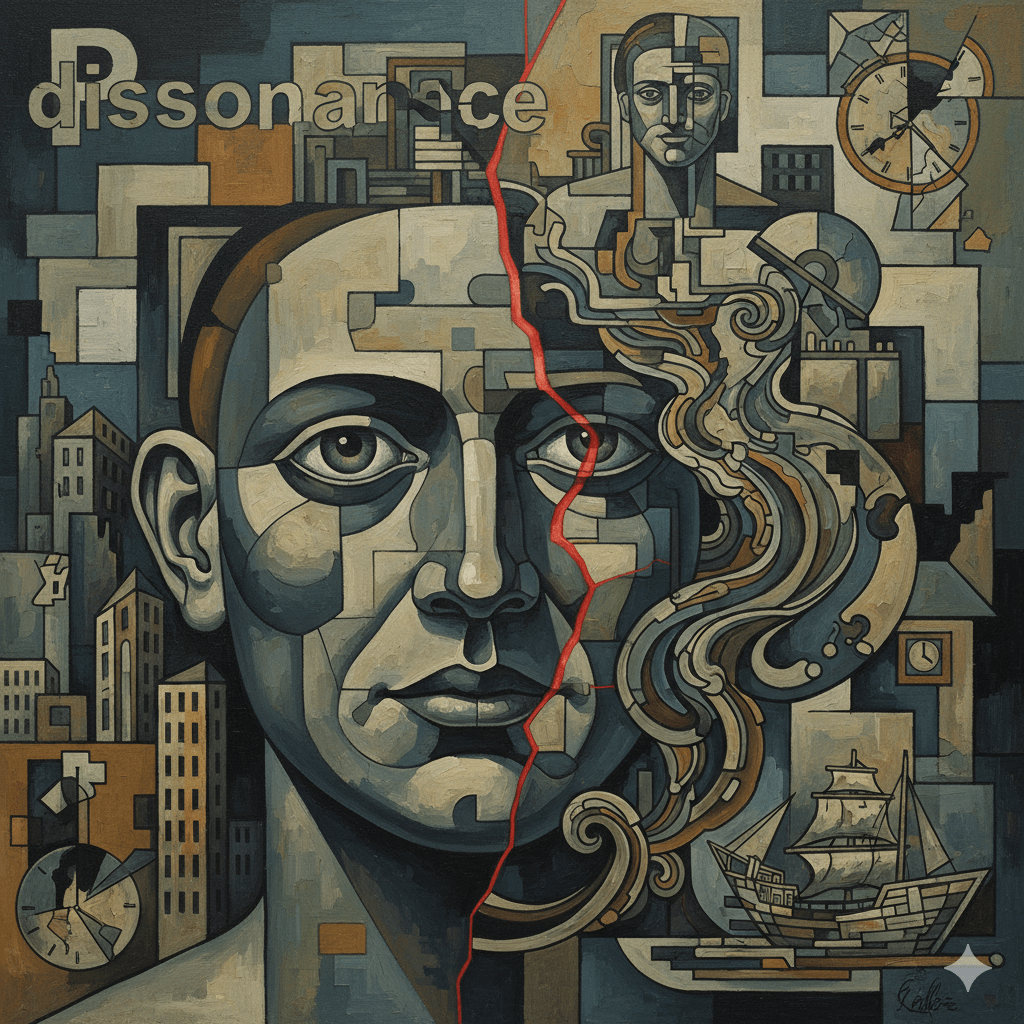
In the landscape of ethical and metaphysical inquiry, the pursuit of coherence stands as a paramount ideal. From ancient philosophy to modern psychology, the virtuous life is often predicated on a seamless alignment between internal conviction and external action. This manuscript challenges that foundational assumption. It posits that a state of perfect, frictionless coherence is not merely difficult to attain but is an ontological impossibility for any finite, self-aware being existing in time. We propose the Principle of Necessary Dissonance, a thesis that holds that a dissonant gap between a being’s internal state—its beliefs, principles, and self-conception—and its external manifestation is an unavoidable and defining condition of existence.
This inherent dissonance is the formal structure of what is colloquially, and often pejoratively, termed “hypocrisy.” The argument that follows is not a defense of moral hypocrisy—the willful deception or cynical manipulation of this gap. Rather, it is an attempt to de-moralize the phenomenon at its root, revealing it not as a contingent personal failing but as a necessary ontological feature. To exist as a finite, conscious self is to be, in a structural sense, dissonant. Failure to recognize this may be the most profound failure of self-knowledge. This post will develop this principle through four convergent lines of argumentation: finitude, temporality, language, and the inherent accident.
The Problem: The Unattainable Demand for Frictionless Self-Knowledge
The conventional view of personal integrity hinges on the concept of coherence. Authenticity is framed as a state where one’s actions are a direct and transparent expression of one’s deeply held values (Taylor, 1991). This model demands a form of self-possession so total that no action can deviate from a pre-established set of internal principles. The ideal subject is a logically consistent entity, whose life follows from their beliefs as a conclusion follows from a set of axioms. This is the implicit goal of many ethical systems, from Kantian deontology to modern frameworks for values-based living discussed in our approach to ethical frameworks.
The problem with this ideal is that it contains a hidden, and fatal, logical impossibility. For an entity to be perfectly non-hypocritical, it must operate from a complete and consistent internal model of itself—a model that accounts for all its beliefs, values, and the justifications for its potential actions in any context. As we will see, the very structure of self-awareness precludes the possibility of such a model. The demand for perfect coherence is a demand that a finite system achieve a form of logical totality that has been shown to be impossible in other formal systems (Hofstadter, 1979).
A Theory of Structural Dissonance
This post posits a formal theory to describe this unavoidable gap. We must first define our key terms with precision. Coherence refers to the state of perfect, frictionless alignment between an entity’s professed principles and its executed actions. Ontological Dissonance is the structural, amoral, and unavoidable gap between these principles and actions, arising from the inherent limitations of a finite, temporal, and linguistic being. In contrast, Moral Hypocrisy is the conscious, willful exploitation of this dissonance for gain, typically characterized by a steadfast denial that the dissonance exists.
The central thesis is that Ontological Dissonance is a necessary and defining feature of conscious existence. It is not a bug to be eliminated but a fundamental aspect of our operating system. This theory does not provide an excuse for moral failings; rather, it provides a more accurate map of the ethical terrain. By understanding the structural nature of this gap, we can better address the moral challenges it presents. This perspective reframes the goal of ethics away from an impossible quest for perfect consistency and toward the more practical and honest task of navigating our inherent contradictions, a theme previously explored in the challenge of applied ethics.
Evidence: Four Arguments for Necessary Dissonance
The Argument from Finitude: The Incomplete Self
The aspiration for perfect coherence is a demand for a complete and consistent internal self-model. Let us formalize this. Consider a finite, self-aware being ($B$). For $B$ to achieve perfect coherence, it must possess a complete and consistent internal model ($M$) of itself. This model, $M$, is a part of the being, $B$, that it purports to describe, so $M \subset B$. For $M$ to be a complete model of $B$, it must accurately model all of B’s constituent parts. Since $M$ is itself a part of $B$, it follows that $M$ must contain a complete and consistent model of itself, let us call it $M’$. This generates an infinite regress within the finite being. A finite entity cannot contain an infinite series.
This is a philosophical analogue to Gödel’s incompleteness theorems, which demonstrate that any sufficiently complex formal system cannot be both complete and consistent (Gödel, 1931). The self, as a system of reflexive consciousness, is precisely such a system (Penrose, 1994). There will always be an un-modeled, un-theorized remainder within the self. The “I” who professes a principle is the “I” of the incomplete model ($M$). The “I” who acts is the total being ($B$), which includes the un-modeled remainder. When an action emerges from this un-modeled depth, it appears, from the perspective of $M$, as a hypocritical deviation.
The Argument from Temporality: The Self in Flux
The ideal of coherence implicitly assumes a static, unchanging self. This notion of the self as a stable “Being” is an illusion; a conscious entity is a process, a continuous “Becoming” (Whitehead, 1929). A principle ($P$) is formulated at time $t_1$ by the self at that moment ($S_1$). An action ($A$) that tests this principle occurs at a later time, $t_2$, performed by the self at that moment ($S_2$). The crucial point is that $S_1$ is not identical to $S_2$. The interval between $t_1$ and $t_2$ has been filled with a ceaseless flow of new experiences, physiological changes, and shifts in disposition (Nader et al., 2000).
A perfect correspondence between the principle of $S_1$ and the action of $S_2$ is a categorical impossibility. It would require a self that exists outside of time, immune to the transformative effects of experience. Such a self would be a static object, not a living subject, as the continuity of identity itself is a complex and debated philosophical problem (Parfit, 1984). The dissonance we call hypocrisy is the audible friction between the self that was, the self that is, and the idealized self that never was. This constant evolution is central to our understanding of the philosophy of self.
The Argument from Language: The Universal and the Particular
Our principles are articulated in language, which trades in universals. An ethical principle, such as “be just,” is an abstract formulation intended to apply to a multitude of situations (Cocchiarella, 1989). Reality, however, is always and infinitely particular. The application of a universal principle to a particular situation is not a simple deduction; it is a violent act of translation. According to moral particularism, we must strip the situation of its unique features to make it fit the abstract category, a process which may ignore morally relevant features (Dancy, 2004).
This process necessarily discards information. The resulting action is a compromise—a translation that is inevitably lossy. It is an action tailored not to the situation in its full particularity, but to the linguistic category we have forced upon it. The dissonance arises from the gap between the clean, universal ideal as articulated in language and the messy, particular deed as executed in reality. Hypocrisy is the shadow cast by the universal as it attempts to grasp the particular. It is the irreducible remainder of reality that escapes the net of our words, a problem we previously touched upon in the limits of models.
The Argument from the Inherent Accident: The Ontology of Failure
Drawing from philosopher Paul Virilio, we can posit that the invention of any positive reality is simultaneously the invention of its specific, inherent form of failure (Virilio, 2007). To invent the ship is to invent the shipwreck. The accident is not an external risk but an internal, necessary potentiality co-created with the substance itself. We can apply this “ontology of the accident” to the self. We constitute ourselves through the adoption of principles and values—a form of psychic and ethical technology.
As a constituted positive reality, the principled self ($S$) must co-create its own specific accident ($-S$). What is the inherent accident of a system of principles? It is the necessary failure to perfectly instantiate those principles. The moment a being defines itself by a principle (“I am honest”), it simultaneously invents its own necessary mode of failure (the specific lie it is now destined to tell) (Armitage, 2000). Dissonance is not a bug in the system of the self; it is a feature. It is the shipwreck that is immanent within the ship of identity. The more rigidly we build the ship, the more dramatic is the form of its necessary wreck.
Potential Objections and Counterarguments
This theory faces several legitimate objections. A proponent of virtue ethics might argue that while perfect coherence is impossible, the gap can be narrowed to an infinitesimal degree through the cultivation of character and habit (Aristotle, trans. 2004). From neuroscience, one could argue that neuroplasticity allows for the intentional retraining of neural pathways to better align behavior with professed goals, making dissonance a solvable technical problem, not an ontological necessity (Dehghani et al., 2016). Finally, a pragmatist might object that this entire framework, by de-moralizing dissonance, provides a sophisticated excuse for moral laziness and a dereliction of the duty to strive for self-improvement. These objections are substantive and will be addressed in future work, but our current thesis maintains that while the degree of dissonance may be variable, its existence is structural.
Synthesis: The Two Forms of Hypocrisy
The four arguments converge on a single conclusion: Ontological Dissonance is an ineliminable feature of the finite, conscious self. The perfectly coherent individual is a metaphysical impossibility. This understanding forces us to distinguish between the two forms of hypocrisy. The first, Ontological Dissonance, is the unavoidable structural condition. It is amoral, a simple fact of being. The second, Moral Hypocrisy, is the conscious exploitation of this dissonance, characterized by a denial of the gap itself. The true moral failing is not the existence of the gap between our words and deeds, but the pretense that no such gap exists. This distinction is critical for developing robust models of human behavior.
Implications: A New Framework for Ethical Navigation
If perfect coherence is impossible, the ethical project must be reframed. The goal is not to build a “crash-proof” self, but to become a skilled navigator of our own necessary dissonance. This requires a new set of virtues. First, intellectual rigor: the ability to recognize one’s own logical inconsistencies without self-deception. Second, temporal humility: the acceptance that one is not the same person who made yesterday’s promises. Third, linguistic honesty: the admission that our principles are inadequate before the complexity of reality. Finally, ontological courage: the capacity to confront our failures not as alien intrusions but as the necessary shadow of our ideals, a stance echoing existentialist calls to embrace contradiction (Camus, 1955).
Conclusion: The Authentic Self as a Skilled Navigator
The arguments from finitude, temporality, language, and the inherent accident establish that dissonance is a structural feature of the conscious self. The ideal of the perfectly coherent, non-hypocritical individual is a fiction. To exist is to be in a state of perpetual contradiction between the self we profess and the self that acts. Authenticity, in this new light, is not the achievement of perfect coherence. It is the integrity to integrate the accident, to acknowledge and take responsibility for the dissonance that defines us. It is the difficult, lifelong work of facing our own structural hypocrisy without cynicism and without denial, and in doing so, achieving a more profound and truthful form of self-knowledge.
End Matter
Assumptions
- This argument assumes that consciousness is reflexive, meaning the system (the self) is capable of attempting to model itself.
- It assumes a linear and transformative experience of time, where the past, present, and future are distinct and the self is altered by its passage.
- It assumes that human ethical systems are primarily articulated and mediated through abstract language.
Limits
- This theory does not address non-human or hypothetical forms of consciousness (e.g., AI, collective intelligence) that may not share these limitations.
- The argument is primarily logical and philosophical; it does not make empirical claims about the measurable degree of dissonance in individuals.
- It does not distinguish between different types of principles (e.g., moral, aesthetic, practical) and the varying degrees of dissonance they might generate.
Testable Predictions
- If this theory is correct, then systems designed to enforce perfect behavioral coherence (e.g., rigid ideological programs, stringent personal productivity systems) should exhibit a higher rate of catastrophic failure (burnout, rebellion) rather than a linear progression toward their ideal.
- Individuals who report a high degree of self-awareness and honesty should also be more likely to acknowledge their own hypocrisy, a phenomenon consistent with cognitive dissonance research (Festinger, 1957).
- Therapeutic or developmental models that focus on accepting and managing internal contradictions should prove more effective in the long term than those aimed at eliminating them entirely.
References
Aristotle. (2004). Nicomachean ethics (W. D. Ross, Trans.). Dover Publications.
Armitage, J. (2000). Paul Virilio: From modernism to hypermodernism and beyond. Sage Publications.
Camus, A. (1955). The myth of Sisyphus and other essays (J. O’Brien, Trans.). Alfred A. Knopf.
Cocchiarella, N. B. (1989). Conceptualism, realism, and the problem of universals. Topoi, 8(1), 77–88. https://doi.org/10.1007/BF00141441
Dancy, J. (2004). Ethics without principles. Oxford University Press.
Dehghani, M., Sachdeva, S., & Pan, X. (2016). The neurological basis of cognitive-behavioral therapy: A review of the literature. The Journal of Neuropsychiatry and Clinical Neurosciences, 28(2), 78–86. https://doi.org/10.1176/appi.neuropsych.15070274
Festinger, L. (1957). A theory of cognitive dissonance. Stanford University Press.
Gödel, K. (1931). Über formal unentscheidbare Sätze der Principia Mathematica und verwandter Systeme I. Monatshefte für Mathematik und Physik, 38(1), 173–198. https://doi.org/10.1007/BF01700692
Hofstadter, D. R. (1979). Gödel, Escher, Bach: An eternal golden braid. Basic Books.
Nader, K., Schafe, G. E., & Le Doux, J. E. (2000). Fear memories require protein synthesis in the amygdala for reconsolidation after retrieval. Nature, 406(6797), 722–726. https://doi.org/10.1038/35021052
Parfit, D. (1984). Reasons and persons. Oxford University Press.
Penrose, R. (1994). Shadows of the mind: A search for the missing science of consciousness. Oxford University Press.
Taylor, C. (1991). The ethics of authenticity. Harvard University Press.
Virilio, P. (2007). The original accident (J. Rose, Trans.). Polity Press.
Whitehead, A. N. (1929). Process and reality: An essay in cosmology. Macmillan.
 Andreas S. Savva | Savva Laboratories