
Introduction: Beyond Representation
For Gilles Deleuze, cinema is not a medium that represents reality—it is a medium that thinks. In his seminal works, Cinema 1: The Movement-Image (1983) and Cinema 2: The Time-Image (1985), Deleuze advances a profoundly ontological claim: the cinematic image is not a secondary copy of the world but an autonomous mode of being, a presentation of time and movement itself. Each cinematic regime, as he terms it, expresses a distinct and irreducible relationship among movement, perception, and time. The classical cinema of the movement-image organizes experience through a closed sensory-motor circuit, where action follows perception. The modern cinema of the time-image emerges when this circuit breaks, revealing the pure, unmediated structure of duration.
This essay’s objective is not primarily exegetical but constructive. It proposes an original cinematic structure—a thought experiment titled The Crystal Gaze—designed to instantiate Deleuze’s philosophy in form. Rather than analyzing an existing film, we will reverse-engineer a cinematic object from its philosophical blueprint. In doing so, this analysis aims to reveal the precise mechanics by which cinema can operate as a machine for philosophical production, generating concepts immanently rather than merely illustrating them.
The Problem: The Crisis of the Sensory-Motor Schema
Deleuze’s entire cinematic taxonomy is built upon a fundamental problem: the breakdown of the connection between perception and action. To understand this crisis, one must first grasp the regime it displaced: the world of the movement-image, which dominated cinema for its first several decades.
The Classical Regime: The Movement-Image and Causal Action
The movement-image corresponds to classical cinema, exemplified by Hollywood, in which perception and action form an unbroken, coherent circuit. A character perceives a situation, the situation prompts a response, and the character executes an effective action. This is the logic of the duel, the chase, the comedic routine—a world ordered by clear causality and represented through narrative techniques like continuity editing, motivated cuts, and linear plot progression. In this regime, time is subordinated to action; it is measured by the unfolding of events. Deleuze identifies this cinematic logic with the sensory-motor schema outlined by Henri Bergson in Matter and Memory (Deleuze, 1986; Bergson, 1991). For Bergson, perception is not a disinterested recording of the world but a pragmatic filtering mechanism that selects only what is necessary for the body to act.
The Rupture: When Characters Can Only See, Not Act
Following the physical and moral catastrophes of the Second World War, Deleuze argues that cinema entered a profound crisis of action. The sensory-motor link, once taken for granted, no longer seemed credible. Individuals were confronted with situations—the ruins of cities, the trauma of the camps, the absurdity of bureaucracy—that were too vast, shocking, or incomprehensible for an effective, goal-oriented response. As D. N. Rodowick notes, the post-war world presented “situations to which one could no longer react” (Rodowick, 1997). From this rupture emerged a new kind of cinematic figure: not an agent, but a seer, a voyant. These were characters who could only wander and look, trapped in situations they could not influence. This shift is most visible in Italian Neorealism, which, as André Bazin argued, privileged ambiguous reality over narrative artifice (Bazin, 2005).
The Theory: Deleuze’s Taxonomy of Cinematic Images
From the crisis of action, Deleuze builds his taxonomy. The failure of the old model did not signal the end of cinema but rather the birth of a new power: the capacity to make time itself visible and audible.
The Movement-Image: The Link Between Perception and Action
As established, the movement-image subordinates time to movement and movement to narrative action. It is composed of three primary types of images: perception-images (what characters see, e.g., a point-of-view shot), affection-images (what characters feel, e.g., a close-up on a face), and action-images (what characters do). These components are locked together in a causal chain, creating a world where problems are posed and resolved through physical acts. The spectator’s mind is guided effortlessly through the narrative by this logic, experiencing a world that makes immediate sense.
The Crystal-Image: Indiscernibility of the Actual and the Virtual
The crystal-image is Deleuze’s most radical and complex figure, marking the pivot from the movement-image to the time-image. It is the point at which the actual and the virtual become indiscernible. The actual is the present, the physically real; the virtual is its memory, its reflection, its dream, its potential past or future. “The crystal-image,” Deleuze writes, “is the indivisible unity of an actual image and its virtual image” (Deleuze, 1989, p. 69). A classic example is a character looking into a mirror, but the reflection acts independently. Which is real? Which is the memory? The crystal-image refuses to answer. It presents both planes simultaneously, creating a circuit where time splits and folds back on itself. As Patricia Pisters describes, it reveals a “crystal-like universe where multiple temporalities and layers of reality coexist” (Pisters, 2003, p. 45).
The Time-Image: Pure Optical and Sound Situations (Opsigns and Sonsigns)
When the sensory-motor link is definitively broken, the image is liberated from its narrative duties. This gives rise to a cinema of pure optical and sound situations—what Deleuze calls opsigns and sonsigns. An opsign is an image that is purely contemplative; it does not set up an action or advance a plot. Think of a long, static shot of a decaying building or an empty landscape in a film by Antonioni or Ozu. These “still life” moments in Ozu’s films, for example, suspend narrative and present pure, contemplative visual spaces (Schrader, 1972). An opsign is an image that forces us to see for the sake of seeing. A sonsign is its auditory equivalent—a sound disconnected from a visible source or narrative cause. These pure images and sounds make visible and audible the very flow of time, which Deleuze, following Bergson, calls duration.
Evidence: Constructing the Crystal Gaze
To demonstrate this theory in action, we turn to our thought experiment, the fictional film The Crystal Gaze. Its three-act structure is designed to force the spectator through Deleuze’s cinematic regimes.
Session 1: Embodying the Movement-Image in the Analyst’s World
The film opens in the world of the Analyst. His environment is sterile, symmetrical, and meticulously controlled, mirroring the classical world of ordered motion. Every gesture—writing a note, adjusting a chair, walking across the room—is a direct and effective reaction to an intelligible stimulus. The camera obeys this logic. Shots are motivated by character action, spatial relations are consistent through classic editing techniques (shot-reverse-shot, establishing shots), and the sound design is diegetic and subordinate to the action on screen. The spectator is situated in a coherent, causal world: the sensory-motor schema is intact.
Session 2: Formal Collapse and the Genesis of the Time-Image
The second session, or act, materializes the crisis of action formally. The editing fractures into jump cuts; sound from one scene bleeds into another without logic; the 180-degree rule is broken, collapsing spatial coherence. The Analyst’s controlled world disintegrates into indeterminacy. The camera no longer records purposeful actions but lingers on errant perceptions: the distorted reflection of a face in a glass of water, the shadow of a passing bird, the sound of rain falling in an otherwise silent room. These are the opsigns and sonsigns Deleuze describes. The spectator, like the characters, experiences a profound disorientation. The failure of action liberates perception, which now becomes autonomous and contemplative, a hallmark of modern cinema (Deleuze, 1989).
Session 3: A Cinema of Pure Duration
The final act is constructed entirely within the time-image regime. Narrative dissolves completely. Instead of plot, the film presents pure duration. We are shown extended, static shots: a woman reading silently for several minutes, rain trailing slowly down a windowpane, firelight reflected on the surface of water. Characters are present not as agents but as seers, absorbed into the temporal landscape. The camera is no longer motivated by their perspective; it observes time thinking itself. This use of “dead time” forces contemplation and makes temporality itself the subject, a technique analyzed by theorists like Raymond Bellour in relation to photographic stasis within the cinematic flow (Bellour, 1990). The film thus becomes a thinking apparatus, a mode of direct philosophical experience.
Objections: Addressing Critiques of Deleuze’s Cinema Philosophy
Deleuze’s framework, while generative, is not without its critics. A rigorous application requires acknowledging potential objections to its totalizing scope and philosophical method.
The Challenge of Falsifiability and Empirical Grounding
A primary critique is that Deleuze’s taxonomy is a philosophical system imposed upon cinema rather than an empirical theory derived from it. Cognitivist theorists like David Bordwell argue that such “Grand Theories” often lack explanatory precision and falsifiability (Bordwell, 1989). The categories—movement-image, time-image, crystal-image—are not easily falsifiable. How could one prove that a given shot is not an opsign? The framework’s strength is its conceptual power, but this is also its weakness. It risks becoming a closed loop where every film can be made to fit the theory, rather than the theory being tested against the film.
The Critique of Ahistoricism and Cinematic Specificity
Another significant objection concerns ahistoricism. While Deleuze gestures toward historical events like WWII as the catalyst for the time-image, critics argue he downplays the specific industrial, technological, and cultural contexts of film production. Robert B. Ray, for instance, suggests that cinematic styles are often driven by specific historical and cultural conditions that a broad philosophical schema may overlook (Ray, 1985). The rise of the time-image could also be linked to the advent of lighter cameras, new funding models for art-house cinema in Europe, or specific national aesthetic movements that had little to do with a universal crisis of action.
The Question of Audience Reception vs. Ontological Status
Finally, there is a debate over where the “thinking” in cinema actually occurs. Deleuze’s claim is ontological: the cinema itself thinks. However, a cognitivist or phenomenological approach would argue that the “thought” is constructed in the mind of the spectator as a process of inference and hypothesis testing (Anderson, 1996). The film provides certain stimuli—ambiguous images, disjointed sounds—and the viewer’s brain works to make sense of them. In this view, the film is not a thinking machine, but a trigger for the spectator’s own cognitive and affective processes. Deleuze’s project intentionally brackets the empirical spectator in favor of the immanent potentials of the image itself.
Synthesis: The Möbius Band as Narrative and Ontological Form
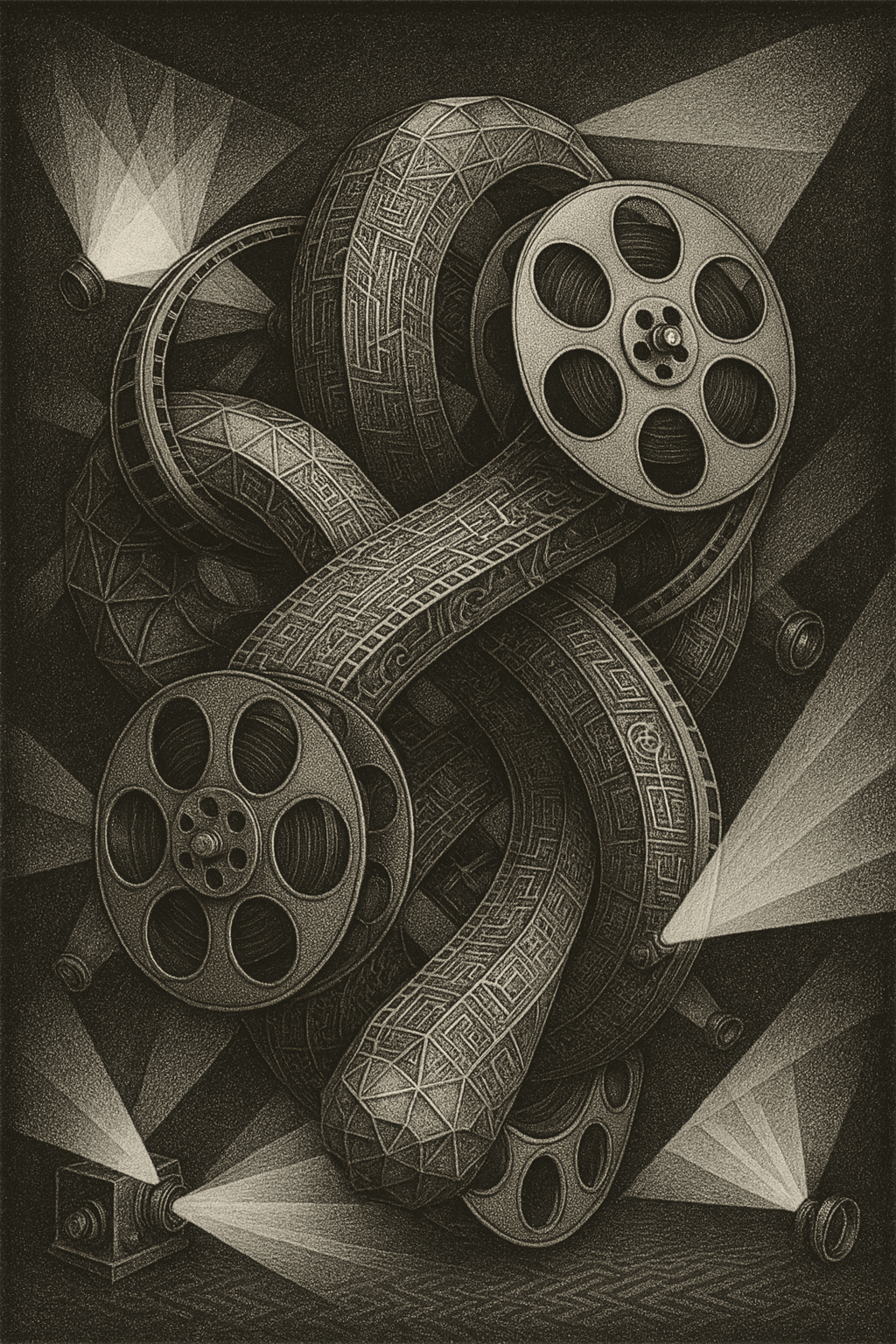
The architecture of The Crystal Gaze is designed to follow the topology of a Möbius strip, a key figure in Deleuze’s philosophy of difference and repetition (Deleuze, 1994). This structure is not merely a metaphor but a formal principle: a one-sided surface where traveling a full circuit results in arriving at the starting point, but inverted. In the context of the film, this means the end must formally echo the beginning while subverting its meaning. In this model, repetition is not the recurrence of the identical but the production of difference through each recurrence.
Each core motif in the film—a door, a mirror, a notebook, the element of water—returns across the three image-regimes, but its meaning is transformed by its new context. The door, a simple threshold of control in the movement-image section, becomes a point of spatial indiscernibility in the crystal-image section, and finally an exit into pure, un-narrated potential in the time-image section. The film’s final scene formally repeats its opening shot, but its meaning is inverted. What was once order is now openness; what was once control is now release. The Möbius topology fuses narrative structure and ontology: the film’s form is the philosophical argument. It performs difference rather than merely representing it.
Implications: The Spectator as a Component of the Machine
Deleuze’s cinema does not simply present images for a detached observer; it directly implicates the act of perception itself. The spectator is not outside the film but is folded into its very structure. By systematically breaking the sensory-motor schema, The Crystal Gaze transforms the viewer from a passive consumer of narrative into an active thinker of time.
When confronted with pure opsigns and sonsigns, the viewer is forced to supply the connections that the film refuses to make. This act of “thinking the interval” between images is where the spectator becomes a component of the cinematic machine, experiencing the film’s affective force directly on the body (Shaviro, 1993). In the final scene, as the camera’s gaze meets the viewer’s, the circuit is completed. The spectator is momentarily trapped inside the Möbius fold, implicated in the structure they have been watching. This is the traversal of fantasy enacted not on the level of story, but on the level of pure cinematic form.
Conclusion: Cinema as an Autonomous Mode of Thought
Through its formal evolution from action to contemplation, cinema has not merely reflected historical change—it has produced new possibilities for thought. The constructed case of The Crystal Gaze serves as a philosophical demonstration of Deleuze’s most vital claim: cinema is an autonomous mode of thinking. Where the movement-image makes sense through action and the time-image makes sense through duration, the true innovation lies in showing that images can generate concepts immanently, without mediation by language or pre-existing narrative codes. Philosophy, cinema, and art, in this view, are parallel disciplines, each creating its own concepts, affects, and precepts (Deleuze & Guattari, 1994).
The Möbius structure collapses the boundary between viewer and viewed, form and content, perception and time. In doing so, it enacts philosophy rather than illustrating it. The spectator exits not simply entertained or enlightened, but perceptually transformed—folded into the cinematic thought that Deleuze called “the movement of world itself.”
Assumptions
- This analysis assumes the validity of Deleuze’s Bergsonist framework, particularly the concepts of duration and the sensory-motor schema as foundational to understanding perception.
- It assumes that a film’s formal structure can be treated as a philosophical argument, separate from the intentions of a hypothetical director or the demands of the film industry.
- It presupposes that the distinction between “classical” and “modern” cinema corresponds meaningfully to the ontological shift from the movement-image to the time-image.
Limits
- This essay does not address the political economy of film production, which significantly constrains the formal possibilities of cinema.
- The analysis is purely theoretical and does not engage with empirical audience reception studies, which might challenge the claim that films force spectators into a new mode of thought.
- The framework is Eurocentric in its primary examples (Italian Neorealism, French New Wave), and this analysis does not explore its applicability to non-Western cinematic traditions, a critique raised by scholars calling for a more global perspective on film theory (Gabriel, 1989).
Testable Predictions
- Formal Analysis Prediction: A quantitative analysis of films widely considered examples of the “time-image” (e.g., works by Tarkovsky, Antonioni) would reveal a statistically significant higher average shot length and a lower frequency of cuts motivated by character action compared to films from the “movement-image” era (e.g., works by Hawks, Ford).
- Reception Study Prediction: If a short film were created according to the principles of The Crystal Gaze, viewers with high cinematic literacy would be more likely to describe their experience in terms of temporal or perceptual disorientation, whereas viewers with low cinematic literacy would be more likely to report confusion or boredom, indicating the cognitive demand of the time-image.
- Neuro-cinematic Prediction: Using fMRI or EEG, researchers could predict that viewing sequences dominated by movement-images would show heightened activity in brain regions associated with motor planning and action simulation. Conversely, viewing time-image sequences (opsigns) would show greater activity in regions associated with contemplation, memory, and default mode network activity.
References
- Anderson, J. D. (1996). The reality of illusion: An ecological approach to cognitive film theory. Southern Illinois University Press.
- Bazin, A. (2005). What is cinema? Vol. 2. (H. Gray, Trans.). University of California Press. (Original work published 1962).
- Bellour, R. (1990). The analysis of film. (C. Penley, Ed.). Indiana University Press.
- Bergson, H. (1991). Matter and memory. (N. M. Paul & W. S. Palmer, Trans.). Zone Books. (Original work published 1896).
- Bordwell, D. (1989). Making meaning: Inference and rhetoric in the interpretation of cinema. Harvard University Press.
- Deamer, D. (2016). Deleuze’s cinema books: Three introductions to the taxonomy of images. Edinburgh University Press.
- Deleuze, G. (1986). Cinema 1: The movement-image. (H. Tomlinson & B. Habberjam, Trans.). University of Minnesota Press. (Original work published 1983).
- Deleuze, G. (1989). Cinema 2: The time-image. (H. Tomlinson & R. Galeta, Trans.). University of Minnesota Press. (Original work published 1985).
- Deleuze, G. (1994). Difference and repetition. (P. Patton, Trans.). Columbia University Press. (Original work published 1968).
- Deleuze, G., & Guattari, F. (1994). What is philosophy?. (H. Tomlinson & G. Burchell, Trans.). Columbia University Press.
- Gabriel, T. H. (1989). Third cinema as guardian of popular memory: Towards a third aesthetics. In J. Pines & P. Willemen (Eds.), Questions of third cinema (pp. 53-64). BFI Publishing.
- Marks, L. U. (2000). The skin of the film: Intercultural cinema, embodiment, and the senses. Duke University Press.
- Pisters, P. (2003). The matrix of visual culture: Working with Deleuze in film theory. Stanford University Press.
- Ray, R. B. (1985). A certain tendency of the Hollywood cinema, 1930-1980. Princeton University Press.
- Rodowick, D. N. (1997). Gilles Deleuze’s time machine. Duke University Press.
- Schrader, P. (1972). Transcendental style in film: Ozu, Bresson, Dreyer. University of California Press.
- Shaviro, S. (1993). The cinematic body. University of Minnesota Press.
 Andreas S. Savva | Savva Laboratories