
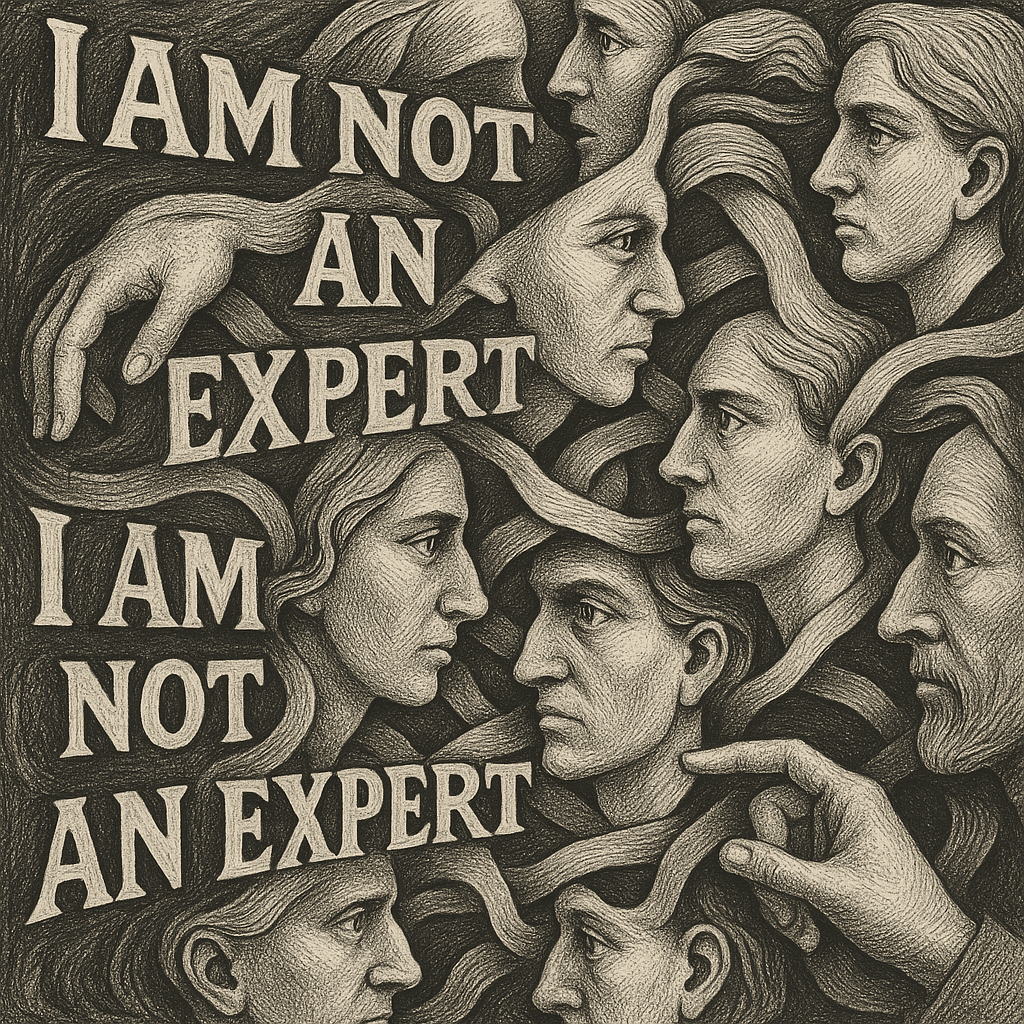
Introduction: The Rise of Epistemic Disavowal
In contemporary discourse, a specific phrase has become nearly ubiquitous: “I am not an expert, but…” This declaration precedes opinions on everything from epidemiology to foreign policy. It functions not merely as rhetorical politeness but as a crucial symbolic operator for structuring speech, authority, and liability. This post proposes the concept of epistemic disavowal to capture this phenomenon. Epistemic disavowal is defined as a discursive act in which a speaker simultaneously makes a knowledge claim while preemptively rejecting the authoritative status typically required to make such a claim, thereby insulating the claim from standard burdens of accountability.
This analysis argues that epistemic disavowal is a structural response to a dual crisis: the widespread erosion of traditional epistemic authority and the heightened personal risks associated with public assertion in a neoliberal, digitally mediated environment. Through a threefold analysis covering this crisis of authority, the libidinal economy of the gesture, and a formal model of its operation, this post will demonstrate how the phrase mediates knowledge, risk, and social fantasy. We will furnish empirical examples, examine the limits and pathologies of this practice, and conclude with a proposal for a more rigorous and responsible mode of public speech.
Setting the Problem: From Rhetorical Hedge to Structural Necessity
The observation that individuals qualify their claims is not new. However, the sheer frequency and automaticity of the phrase “I’m not an expert” signals a qualitative shift. It appears in op-eds, social media threads, podcasts, and policy debates, functioning as a mandatory password for entry into contested discursive fields. Its prevalence demands we move beyond seeing it as a simple hedge and instead analyze it as a structural mechanism.
The key questions animating this inquiry are:
- What precise function does this phrase perform in the contemporary political-epistemic field?
- How does it mediate the relationship between authority, individual responsibility, and symbolic protection?
- In what ways is this practice symptomatic of modern subjectivity under conditions of profound epistemic precariousness?
I argue that “I am not an expert” is less about genuine epistemic modesty than about defensive disavowal. It is a gesture of rhetorical protection that paradoxically maintains the ideal of expertise while denying one’s own participation in it. The phrase acts as a discursive guardrail: it grants permission to speak while attempting to neutralize the risk of being held accountable for being wrong. Consequently, it has become a default posture for navigating contentious public conversations.
The Crisis of Authority: Expertise in an Age of Contestation
The rise of epistemic disavowal is inseparable from the broader decline of public trust in institutions and experts. This context creates the conditions where such a defensive posture becomes not just useful, but necessary for discursive participation.
The Flattening of Deference and the Rise of Symbolic Liability
The democratization of information, while celebrated for its accessibility, has had the secondary effect of flattening epistemic hierarchies. Tom Nichols (2017) argues that this has made cultural deference to specialists suspect, fostering an environment where every claim is potentially open to populist challenge. In this climate, the phrase “I’m not an expert” becomes a survival mechanism. It is a way to participate in public reason without assuming the symbolic liability now attached to expert claims. This erosion is compounded by what others describe as the immense strain placed on traditional expertise by complexity, politicization, and transparency deficits (Chêsta, 2021).
Distinguishing Authority and Expertise in Public Discourse
To understand disavowal, we must distinguish between expertise and authority. Expertise refers to a demonstrated high level of knowledge or skill in a particular field. Authority is the socially recognized power to have one’s claims accepted. One can be an expert without having authority, and vice-versa. A philosopher of ethics (Greppi, 2020) separates epistemic authority (reasons for belief) from practical authority (legitimacy of command). The phrase “I’m not an expert” performs a specific operation: it explicitly disavows epistemic authority while implicitly gesturing toward the necessity of its structure. The speaker simultaneously evacuates and upholds the position of the expert, creating a paradoxical discursive space. This reflects a broader challenge modern speakers face in balancing assertion and authorial humility (Kloster, 2012).
Epistemic Humility, Fallibilism, and the Preface Paradox
From a philosophical standpoint, a degree of epistemic humility is rational. The Preface Paradox (Makinson, 1965) perfectly illustrates this. An author can rationally believe every individual claim in their book is true while also rationally believing that, given the number of claims, at least one of them is probably false. “I am not an expert” functions as a reflexive, conversational performance of this paradox. The speaker makes a series of assertions while a single, overarching disclaimer acknowledges their own fallibility. This aligns with broader philosophical traditions of fallibilism (Zagzebski, 1996) and the rejection of the “KK principle,” the idea that to know something, one must also know that one knows it (Williamson, 2000). Disavowal operationalizes this philosophical uncertainty as a practical tool for discourse.
The Libidinal Economy of Disavowal
Beyond the crisis of public authority, epistemic disavowal is driven by the psychological pressures placed on the individual. It serves a function in what can be termed a “libidinal economy”—a system of psychic investments, desires, and defenses related to speech and identity.
Risk Management and the Neoliberal Subject
Under neoliberal rationality, the individual is reconceived as an entrepreneur of the self, tasked with perpetually managing their own human capital and reputational risk (Brown, 2015). In hyper-visible digital arenas, the social, professional, and psychological cost of being publicly wrong is exceptionally high. Epistemic disavowal thus becomes a primary tool for risk mitigation. If the perceived risk R(s) of a speech act exceeds a speaker’s tolerability threshold ρ, they must deploy a counterbalancing disavowal D(s) to render the speech act viable. This turns discourse from a search for truth into an exercise in managing symbolic liability.
The Performative Superego and Virtue Signaling
Contemporary discourse is governed by powerful, often unspoken, performative norms of modesty and self-accountability (Fraser, 2013). Voicing a strong, unhedged opinion can be perceived as arrogant or domineering. In this context, the phrase “I’m not an expert” functions as a moralized performance of humility. It is a gesture demanded by the ambient superego of digital culture, which punishes hubris and rewards displays of self-awareness. It signals that the speaker understands their place in the epistemic hierarchy and is therefore a “good,” non-threatening participant in the conversation.
The Fantasy of the Absent Master
The psychoanalytic concept of disavowal (Verleugnung), as described by Freud (1927), involves the simultaneous acknowledgment and denial of a troubling reality. The speaker knows the expert exists (or should exist) but refuses to occupy that position themselves. This move props up the fantasy of a perfect, all-knowing Master-Expert who is, unfortunately, absent from the current conversation (Zupančič, 2008). By saying “I am not an expert,” the speaker affirms the symbolic necessity of this Master figure while simultaneously creating a space for their own, less accountable speech. It is a way to have one’s cake and eat it too: to benefit from the structure of expertise without bearing its burdens.
Disavowal as a Structural Operator
Epistemic disavowal is more than a psychological defense; it is a structural operator that reconfigures the rules of discourse itself. It alters the conditions of assertion and refutation.
A Formal Model of Discursive Viability
We can model this operation formally. Let S be a subject, A be a knowledge claim, R(s) be the perceived reputational risk of asserting A, and D(s) be the degree of disavowal attached to the assertion. For a claim to be deemed utterable by the subject, the disavowal must meet a certain discursive threshold δ, which is itself a function of the risk. We can represent this as:
$$D(s) = f(R(s)), \quad \text{with } D(s) \geq \delta \Rightarrow \text{claim utterable}$$
(Note: Your site may require a plugin like MathJax or KaTeX to render the LaTeX formula above.)
The phrase “I am not an expert” is a powerful operator because it almost automatically ensures that D(s) ≥ δ, regardless of the risk level of the claim itself. It is a universal key that unlocks the right to speak on any topic by pre-emptively managing its associated risks.
The Collapse of Refutation and Structural Immunization
A key structural effect of epistemic disavowal is its capacity to immunize the speaker from substantive critique. Because the disclaimer is reflexive and precedes the claim, it can be invoked at any point to deflect a challenge. If another participant points out a factual error or logical flaw, the original speaker can retreat to their initial position: “As I said, I’m not an expert.” This tactic collapses the potential for genuine dialogic rebuttal, which depends on shared accountability. It replaces the process of reasoned argumentation with a series of hedged, non-falsifiable assertions.
Power and Asymmetry in the Right to Disavow
The affordance to successfully disavow expertise is not distributed equally. It is a privilege often reserved for those who already possess a significant degree of social or symbolic capital. For speakers from dominant groups, the disclaimer reads as charming humility. For those from marginalized groups, the same phrase may be interpreted as a confirmation of their incompetence, effectively erasing their contribution. This aligns with critiques of positional epistemologies, which note that the act of speaking and the meaning of speech are conditioned by the speaker’s social location (Alcoff, 1991). The “right to be wrong” is a luxury not all can afford.
Evidence and Examples in Context
The operation of epistemic disavowal is visible across multiple domains of contemporary life, from casual social media interactions to high-stakes policy debates.
Performative Caution on Social Media
On platforms like X (formerly Twitter), where context is limited and audiences are potentially hostile, users frequently preface controversial claims with disclaimers. This reflects a culture of “performative caution” (Baym, 2015), where the primary goal is often to preemptively avoid criticism in a hyper-exposed, often unforgiving environment. The disclaimer acts as a shield in the often-brutal landscape of digital discourse.
Boundary-Setting in Public Intellectual Debates
Public intellectuals and pundits speaking outside their core domain often use a variant of the phrase: “I’m not a virologist, but…” This serves a dual purpose. First, it satisfies the audience’s expectation for humility, signaling respect for genuine expertise. Second, it legitimizes the speaker’s right to speculate or draw analogies, often by framing the issue in moral or political terms (Lakoff, 2004). It is a sophisticated way to navigate interdisciplinary boundaries and maintain credibility with a broad audience.
The Paradox of Hedging in Clinical and Scientific Communication
Interestingly, in some professional contexts, epistemic humility is a documented virtue. Studies in clinical communication show that physicians who transparently acknowledge the limits of their knowledge can foster greater trust with patients (Bensley et al., 2020). However, there is a crucial difference. In the clinical encounter, humility is relational and aimed at building a shared understanding. In public discourse, the same hedging can be interpreted as abdication or weakness, further muddying the waters. The context and intent behind the acknowledgment of limits are paramount.
Synthesis: From Default Disavowal to Situated Speech
The ubiquity of epistemic disavowal presents a problem for a healthy public sphere. It degrades the value of evidence and erodes accountability, replacing rigorous debate with a series of insulated monologues. The challenge is not to eliminate uncertainty but to communicate it responsibly. Rather than retreating into default hedging, I propose an alternative: situated speech. This is a mode of asserting partial authority that is grounded in transparent epistemic scaffolding.
Situated speech consists of four key practices:
- Evidence Transparency: Explicitly frame claims with the nature of their backing. Instead of “I’m not an expert,” say “My reading of the preliminary data suggests…”
- Modal Calibration: Use precise modal qualifiers (e.g., “possibly,” “likely,” “almost certainly”) instead of a blanket disavowal.
- Boundary Awareness: Clearly specify the limits of one’s domain. “My expertise as an economist allows me to analyze the market effects, but I cannot speak to the sociological impacts.”
- Courageous Positionality: Own one’s partial knowledge without shame. This means being willing to be wrong and to revise one’s position in light of better evidence, a stark contrast to the historical ideal of the infallible public intellectual.
Situated speech reframes responsibility. It is not about being all-knowing, but about being accountable for what one does claim to know and how one knows it. It rejects the fantasy of the absent Master-Expert while refusing the comfort of complete epistemic abdication.
Implications and Future Directions
The analysis of epistemic disavowal carries significant implications. For public discourse, it suggests a need to cultivate norms that reward intellectual honesty and courageous positionality over performative humility. For education, it highlights the importance of teaching not just facts, but epistemic virtues: how to assess evidence, how to articulate uncertainty, and how to engage in good-faith debate. For democratic theory, it underscores how micro-level speech acts can have macro-level consequences, shaping the conditions of possibility for collective deliberation and decision-making.
Future research could empirically test the hypotheses presented here. Corpus linguistics could be used to track the frequency and context of disavowal phrases over time. Experimental studies could measure how audiences perceive claims that are hedged versus those that are situated. A deeper dive into critical theory concepts could further illuminate the relationship between this discursive tic and late-modern capitalism.
Conclusion: Beyond the Hedge
“I am not an expert” is not a sign of modesty. It is a complex and powerful symbolic technology—a default mechanism for negotiating the treacherous terrain of contemporary public discourse. It crystallizes the crisis of subjectivity caught between informational excess and authority fatigue, between the desire to speak and the fear of symbolic annihilation. It is the logical, if ultimately corrosive, adaptation to a dysfunctional epistemic environment.
To move forward, we must look beyond the hedge. We must cultivate and practice discursive modes that balance humility with clarity, and vulnerability with intellectual courage. The goal is not to have all the answers, but to be accountable for the answers we choose to offer. This requires moving from the safety of disavowal to the productive risk of situated, responsible speech.
End Matter
Assumptions
- This analysis assumes that speakers are, to some degree, rational actors consciously or subconsciously managing symbolic and reputational capital.
- It assumes that the concept of “expertise” retains a coherent, socially recognized meaning, even if it is currently contested.
- The framework presumes that the examples drawn from Western, English-speaking digital discourse are representative of a broader structural trend.
Limits
- The analysis is primarily theoretical and does not include new quantitative empirical data on the prevalence of the phrase.
- It focuses on linguistic performance and may not fully account for non-verbal or other forms of epistemic disavowal.
- The proposed solution of “situated speech” is an ideal type and may not be achievable in all discursive contexts, particularly those characterized by extreme bad faith.
Testable Predictions
- Prediction 1: In a comparative analysis of online forums, the frequency of epistemic disavowal phrases will be significantly higher in forums with higher reputational stakes and more heterogeneous audiences (e.g., LinkedIn, X) compared to niche, high-trust communities (e.g., specialized academic forums).
- Prediction 2: An experimental study presenting participants with two identical claims—one prefaced with a disavowal and one framed with “situated speech”—will find that the latter is rated as more credible and trustworthy, even if it is also rated as more assertive.
- Prediction 3: Over time, as a discursive field becomes more polarized, the use of epistemic disavowal by participants will increase, correlating with a decrease in direct, substantive rebuttals between opposing sides.
References
- Alcoff, L. M. (1991). The problem of speaking for others. Cultural Critique, (20), 5–32. https://www.jstor.org/stable/1354221
- Baym, N. K. (2015). Personal connections in the digital age. Polity Press.
- Bensley, R. J., et al. (2020). Relational epistemic humility in the clinical encounter. JAMA Network Open, 3(5), e206706. https://doi.org/10.1001/jamanetworkopen.2020.6706
- Brown, W. (2015). Undoing the demos: Neoliberalism’s stealth revolution. Zone Books.
- Chêsta, V. (2021). Expertise under strain. Science and Public Policy, 48(5), 653–665. https://doi.org/10.1093/scipol/scab027
- Fraser, N. (2013). Fortunes of feminism: From state-managed capitalism to neoliberal crisis. Verso.
- Freud, S. (1961). Fetishism. In J. Strachey (Ed. and Trans.), The standard edition of the complete psychological works of Sigmund Freud (Vol. 21, pp. 147-158). Hogarth Press. (Original work published 1927)
- Greppi, A. (2020). Epistemic authority and democratic legitimacy. Critical Review of International Social and Political Philosophy, 23(6), 757–775. https://doi.org/10.1080/13698230.2018.1523176
- Kloster, T. (2012). Speaking with authority (Publication No. 12838) [Doctoral dissertation, Iowa State University]. Iowa State University Digital Repository. https://lib.dr.iastate.edu/etd/12838
- Lakoff, G. (2004). Don’t think of an elephant!: Know your values and frame the debate. Chelsea Green Publishing.
- Makinson, D. C. (1965). The paradox of the preface. Analysis, 25(6), 205–207. https://doi.org/10.1093/analys/25.6.205
- Nichols, T. (2017). The death of expertise: The campaign against established knowledge and why it matters. Oxford University Press.
- Williamson, T. (2000). Knowledge and its limits. Oxford University Press.
- Zagzebski, L. T. (1996). Virtues of the mind: An inquiry into the nature of virtue and the ethical foundations of knowledge. Cambridge University Press.
- Zupančič, A. (2008). The odd one in: On comedy. The MIT Press.
 Andreas S. Savva | Savva Laboratories